Sand Mountain is east of the town of Fallon in western Nevada, It is some three and a half miles long, a mile wide, and 600 feet high. It was formed of sand blown from an ancient dry lake called Lake Lahontan and trapped by the nearby Stillwater Mountains.
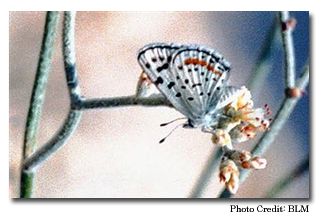
It is a popular off-road recreation site, an activity at odds with the survival of the Sand Mountain Blue Butterfly. Small and pale blue, the butterfly is a declining species depending for its survival on a plant called Kearney Buckwheat, which grows nearby. Kearney Buckwheat also grows elsewhere in Nevada, as well as in California, Arizona, and Utah, but the Sand Mountain Blue Butterfly is found nowhere else. Regulations have been enacted and trails developed to help the butterfly coexist with the many off-roaders who come for recreation.
Sand Mountain is a “singing” sand dune, one where the nature of the sand grains and the weather combine to make the sand emit sounds variously described as whistling, barking, booming, and roaring. The sound can be heard for miles and can rise to 105 decibels, a level between an electric saw and loud orchestral music. There are only a few such sand dunes in the world.