

Route 50 begins in Ocean City, Maryland, just a few blocks from the Atlantic Ocean.

___
Photos by the author.
Route 50 begins in Ocean City, Maryland, just a few blocks from the Atlantic Ocean.
___
Photos by the author.
Turn south on Maryland 611 shortly after leaving Ocean City, and in ten miles you’ll cross Sinepuxent Bay and enter Assateague Island.
THE ISLAND
Assateague is 37 miles long, north to south, divided between Maryland and Virginia. The northern part of the island — the Assateague Island National Seashore — is in Maryland, while the Chincoteague National Wildlife Refuge at the southern end is in Virginia.
Assateague is a barrier island, a formation of sand dunes lying between the ocean and land. Such islands change and move due to weather and tides. Big storms can reshape them, and in 1933 a hurricane drove a channel between Assateague Island and Ocean City.
The Ocean City government saw the new passage’s potential for navigation and built jetties to make it permanent. Today the channel remains, and Assateague, in its character as a barrier island, has moved. It is now west of Ocean City, which can easily be seen in the satellite view of an Internet map.
THE PONIES
Assateague is home to wild ponies. They are feral, which means they are the descendants of once-domesticated ponies that have returned to the wild. Romantics among us prefer to believe that the ponies’ ancestors survived a shipwreck and swam to safety, but they probably were brought to the island from the mainland by their owners, to avoid taxes.
Why are they called ponies, and not horses? The distinction depends in part on their height. Ponies are generally regarded as having a genetic makeup that results in them being less than 14.2 hands in height. This requires some explanation.
The “hand” is a unit used to measure horses in the United States and a few other countries. Over time it has been standardized at four inches, so fourteen hands means four times fourteen, or 56 inches, in height.
But wait — isn’t there a decimal in 14.2? Actually, no. It’s a number that represents quarters of a hand, so “.2” is two quarters of a hand, or two quarters of four inches, or two inches. Therefore, a pony is a horse-like animal standing less than 14 hands plus two inches, or 58 inches, or four feet ten inches, tall.
There’s more. Horse and pony heights are measured, not to the top of the head, but to the “withers,” which is a point between the animal’s shoulder blades. Why? Because a horse’s head moves up and down, but the withers (a singular, not plural, noun) is a constant distance from the ground.
And there’s yet more, but here I’ll just quote a relevant Wikipedia article: “Miniature horses, but not miniature ponies, are measured at the base of the last true hairs of the mane rather than at the withers.” Hmmm. Let’s leave it at that.
PONY POPULATION CONTROL
South of the Maryland-Virginia state line, ponies living on Assateague Island are called Chincoteague ponies. Fencing at the border of the Chincoteague National Wildline Refuge keeps the ponies in two separate populations.
Because Assateague is a barrier island of limited size, the number of ponies living on the island is an issue, and population control is necessary. The northern Assateague ponies live under a contraception regime, but on the Chincoteague side, keeping the population at 150 ponies resulted in the most famous pony activity going.
Each year since 1925, the Chincoteague Volunteer Fire Department, which administers the Chincoteague refuge, conducts an annual event called pony penning. And the book Misty of Chincoteague by Marguerite Henry, published in 1947, has brought this activity to the attention of generations of children. As recounted there, the Chincoteague ponies are rounded up by “saltwater cowboys” and encouraged to swim across a channel to the town of Chincoteague, where some of them are auctioned off.
Is this a cruel thing to do to wild ponies? Apparently not. The ponies are actually feral, not wild, and many years of experience have shown that they re-domesticate quickly.
FLYING CREATURES
Assateague also hosts populations that are not so easily managed. For example, over the course of a year a dedicated birder on the island might observe some 320 bird species. The casual summer visitor, though, is more likely to notice the astounding number of mosquitoes. Be sure to carry lots of genuinely effective mosquito repellent when you visit, or you may have an experience such as mine.
One summer, after setting off down a trail from the parking lot, I happened to look down at my legs. I was wearing shorts, but I couldn’t see the skin of my legs, because mosquitoes covered almost all of it. I fled back to my car, swatting madly. Such occasions have caused the website Wikivoyage to call Assateague the “biting insect hell hole of the Mid-Atlantic.”
So, Assateague Island: Ponies. And insect repellent.
The image at the top of the page is from the Assateague Island National Seashore. It is in the public domain and may be used without a copyright release from the National Park Service.
A little less than ten miles west of Ocean City, Route 50 passes Berlin, Maryland. In 1779, a man named Stephen Decatur was born near what is now Berlin. He was a daring and famous American naval hero. Here is one of his exploits.
* * *
On the night of February 16, 1804, the two-masted U.S. Navy ketch Intrepid sailed into Tripoli harbor, in what is now Libya, on the Barbary Coast of the Mediterranean Sea. Most of the ship’s crew hid beneath closed hatches as the lights of the city and the castle on the bluffs above grew closer. On deck, the ship’s officers were disguised as Mediterranean sailors. Stephen Decatur, their captain, stood with them, his hair pulled back and dark sideburns framing his face and its prominent nose.
Decatur directed his crew to steer the Intrepid through the night toward the largest docked ship, a captured frigate that had once belonged to the U.S. Navy. In the the middle of the harbor, voices called out across the water. The Tripoli harbor patrol had discovered them.
* * *
Decatur and his crew were in Tripoli Harbor because pirates from Tripoli, an Ottoman regency, had been capturing merchant ships and enslaving their crews for more than two centuries. During that time, the United States and European nations paid tribute to the pirates so ships could pass safely. As a result, Tripoli had collected enough booty to fortify the city and build a castle to guard its harbor.
In 1801, the Pasha of Tripoli increased the required tribute. European nations continued to pay, but the U.S. found the new amount unacceptable. In 1803, it dispatched a naval squadron to cow the Pasha and resolve the problem. The squadron included a 40-gun frigate, the Philadelphia.
And thus, one sunny day when the Tripolitan pirates were happily pillaging, they were unpleasantly surprised to see the Philadelphia and its 300-man crew bearing down on them. The pirates fled for the safety of Tripoli harbor. The Philadelphia gave chase, but the waters near the harbor were treacherous, and the Philadelphia ran aground on a sandbank.
The reprieved pirates surrounded the grounded ship. As more and more pirates arrived, the Philadelphia’s captain ordered his crew to push the ship’s cannon overboard, hoping to lighten her enough that she would float off the sandbank. It didn’t work, and when pirate gunboats fired at her, the Philadelphia couldn’t fire back. Her captain surrendered.
The pirates sent the Philadelphia’s crew away to prison and slavery. They hauled the Philadelphia off the sandbank and towed her into the harbor. Then they fished her guns up from the bottom of the bay, remounted them, loaded them, and ran them out ready to fire.
As a result, the Philadelphia represented a potent new pirate threat that the U.S. could not tolerate. The commander on the scene ordered up a raiding party to go into Tripoli harbor and destroy her. The idea was simple enough, but there were a few troublesome details:
A 25,000-man army defended Tripoli, and from the walls of the city and its castle 115 cannon overlooked the harbor. The Philadelphia was anchored well within range of those guns. A fleet of 24 vessels, ranging from galleys to sailing ships, patrolled the harbor itself. Those ships carried another 83 guns and an additional 1,000 men. Assessing the prospects, the U.S. commander said, “It will undoubtedly cost us many lives. But it must be done.”
Lieutenant Stephen Decatur, who commanded a ship in the American squadron, offered to lead the raid. He gathered his ship’s crew on deck and asked for men willing to go with him into Tripoli harbor. Every man volunteered.
Decatur and his men loaded a captured Tripolitan ship, renamed the Intrepid, with “combustibles,” 19th century naval terminology for things that burn fiercely.
On February 3, 1804, they set sail, but a gale blew up before they reached Tripoli. The direction of the wind prevented them from entering the harbor, and they had to wait for the storm to blow itself out. Their ship was about 50 feet long and, at its widest point, 15 feet wide. If you stand on a street corner today and look diagonally across the intersection to the other corner, that’s roughly 50 feet. Fifteen feet is approximately the length of one of today’s passenger cars. Seventy-five men were packed into that 50-by-15 foot space.
During the storm, waves rose above the level of the deck and crashed on board. Anything larger than the smallest scrap of sail quickly blew away, forcing the men to steer using only the pressure of the wind on the ship’s bare masts. For nine days, the ship rocked and pitched with every wave.
Decatur and his four officers shared a single tiny cabin with a ceiling so low they couldn’t stand upright. The midshipmen and the marines had only a crude shelter on deck, and they, too, risked banging their heads on the ceiling — when they sat up. The common sailors slept on top of barrels stored down in the hold. The barrels held the ship’s store of salt meat, but the meat turned out to be rotten, so Decatur and his men ate bread and water.
But in their hours of trial these men were not alone. Before it was captured, their ship had carried enslaved people of poor hygiene, and so they suffered from what one officer called an “attack of innumerable vermin.”
The gale finally subsided on February 16th, and that night Decatur and his men sailed into Tripoli harbor.
* * *
When the harbor patrol hailed the Intrepid, Decatur and his ship were already headed for the Philadelphia. Decatur’s pilot, a Sicilian who knew the harbor, replied in Arabic, saying they were from Malta and had lost their anchors in the storm. Could they tie up next to that big ship over there? The harbor patrol approved. The Intrepid’s crew had passed lines to the Philadelphia when the guards on its deck raised the alarm.
The Intrepid’s raiding party immediately swarmed up from their hiding places. With Decatur in the lead, they scrambled up the side of the larger ship and attacked the Tripolitan guards with cutlasses, pikes, and hatchets. Knots of men fought hand to hand across the deck, grunting and shouting amid the bang of pistols, the clang of edged weapons, and spurts of blood. Twenty guards were killed, and the rest ran for the railings and jumped overboard into the night.
Decatur’s men then handed up the combustibles from the Intrepid. To place and light them, the men climbed down steep ladders inside the Philadelphia and raced along low passageways through the dark, lower decks. Soon fire coursed through the ship. Orange flames leapt out of her hatches and climbed her masts, and acrid smoke choked the raiding party. The fire was so fierce it threatened to burn the Intrepid. The men tumbled back down off the Philadelphia on to their own ship, Decatur the last man off.
As the men pushed the Intrepid away from the Philadelphia and hoisted sail, ships guarding the harbor began to fire. Shore batteries opened fire, too, and cannon balls plummeted about the ship, sending up cascading fountains of water.
To the raiding party’s surprise, heavy guns also opened fire from close behind them. They looked back for this new threat and saw … the Philadelphia. Her guns, primed and shotted, were ready for action, and the heat of the fire set them off one by one, sending cannon balls whistling past the Intrepid and her crew.
Soon, though, the Philadelphia’s cables burned through, and she drifted ashore near the castle. When the flames reached her powder room, she blew up with a huge, deafening explosion. One of the Philadelphia’s captured crew, held prisoner in Tripoli, wrote, “Tumult, consternation, confusion, and delay reigned in every section of the town and castle.”
Decatur and the Intrepid sailed through the uproar and away into the night. Only one Tripolitan shot scored, and they only knew of it when a hole suddenly appeared in a sail above their heads. The total American casualty list: one man wounded.
The story of Decatur’s raid was told around the world. England’s Lord Nelson, the greatest fighting sailor of the time, called it “the most bold and daring act of the age.” When the news reached the United States, it caused a sensation. Decatur was promoted to captain, the youngest ever in the U. S. Navy. Congress awarded the Intrepid’s men an extra two-month’s pay — thirty-four dollars each.
As the country celebrated, a young man was inspired to take a popular English drinking song called “To Anacreon In Heaven” and write new words for it, commemorating Decatur’s feat. A few years later, this same man watched the British bombard Fort McHenry, and he revised his lyrics. And so Francis Scott Key took a song about Stephen Decatur and wrote “The Star Spangled Banner.”
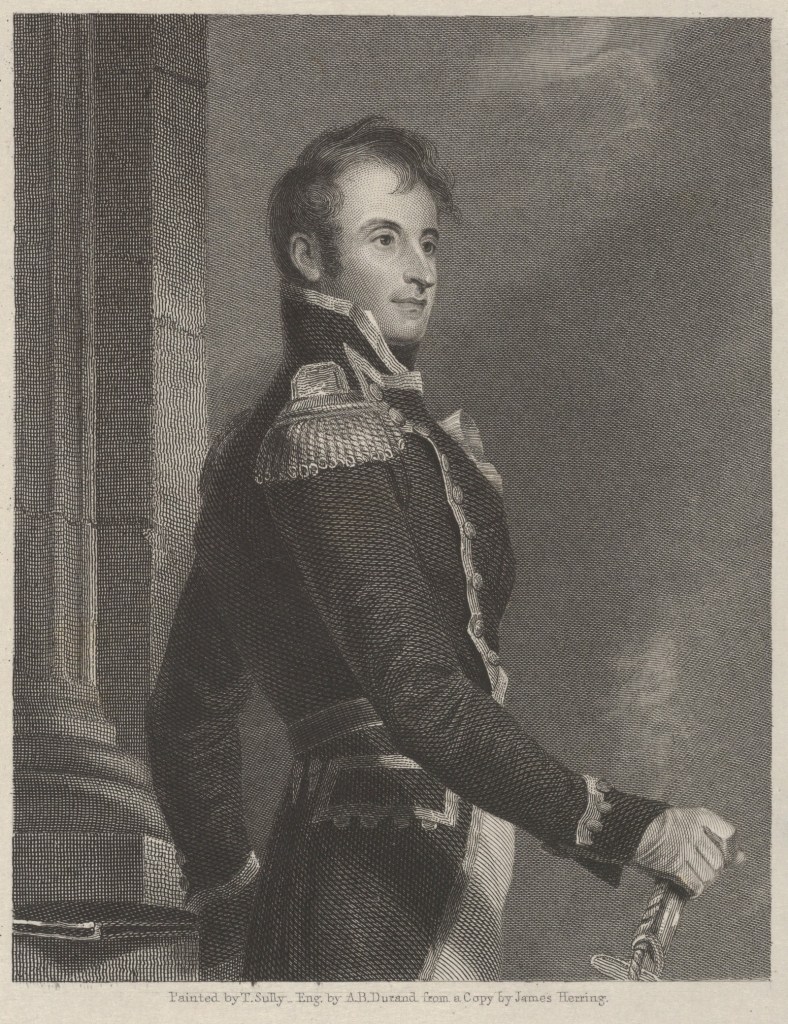
The images on this page are in the public domain.
Today’s Route 50 crosses the DelMarVa Peninsula (Delaware, Maryland, Virginia). This includes a part of Maryland that was quite familiar to Harriet Tubman, one of the most remarkable women in American history.
Harriet Tubman was born into slavery near Cambridge, Maryland in 1822, but in 1849 she freed herself by escaping to Philadelphia. Shortly after, an advertisement offering $100 for her return was placed in a Cambridge newspaper. We know this because copies of the ad still exist today.
She returned to Maryland frequently, but not as an enslaved person. Instead, on thirteen separate occasions she led members of her family and other enslaved people to freedom. She took her charges through the night in secret, using the resources of the Underground Railroad. She preferred to take those dangerous trips in the winter, when nights were longer and concealment easier. She often began them on Friday evenings, knowing the local newspapers wouldn’t report the escape until Monday. Her identity as the person leading these escapes was not known at the time, but as stories of her successes circulated she became known as “Moses,” for leading her people to freedom.
Her summary of that time: “I was conductor of the Underground Railroad for eight years, and I can say what most conductors can’t say – I never ran my train off the track and I never lost a passenger.”
During the Civil War, Tubman worked for the U.S. Army in various capacities, including as the leader of scouting patrols in the Confederate state of South Carolina. On one memorable occasion, she became the first woman to lead an armed assault in the Civil War, guiding troops on an expedition to the Combahee Ferry. That raid freed more than seven hundred enslaved men, women, and children.
But after the war, she struggled to receive a pension such as those awarded to male soldiers, and her activism, including in the campaign for women’s suffrage, kept her impoverished. Supporters had to raise money to help her.
Harriet Tubman died in 1913, at a home for aging African-Americans in Auburn, New York. Years before, she had helped to found that home.
In the photo below, Route 50 crosses southern Maryland between the Atlantic Ocean and the Chesapeake Bay. This section of the highway is dedicated to Harriet Tubman.

___
The photo of Harriet Tubman at the top of this page is in the public domain. The photo of Route 50 was taken by the author.
Turn off Route 50 at Easton, Maryland, and head ten miles east on Maryland Route 33 to St. Michaels. Find a table next to the water at The Crab Claw restaurant.
Order up a mess of blue crabs.

Ply your mallet and paring knife (you can see them in the photo below).

In the end, you will have a genuine mess, but you will have eaten happy.
___
All photos above are by the author.
This is a blue crab, named for its strikingly blue legs. The blue crab’s scientific name, callinectes sapidus, celebrates a combination of color, ability, and tastiness. “Calli” means beautiful in Greek, a tribute to the crabs’ color. “Nectes” is swimmer in Greek — by using their rear legs as paddles, these crabs swim very well. “Sapidus” is savory in Latin, because people like to eat them (see fine dining).
The savoriness of blue crabs means they are widely fished and eaten everywhere they live, from Nova Scotia in the north to Uruguay in the south. One of their favorite places is Chesapeake Bay, where in 2018 an estimated 147 million adult female blue crabs made their homes. Females have reddish tips on their pincers, and thus we know the crab posing for us at the top of the page is a female.
On the way from birth to adulthood, blue crabs molt several times. This means they outgrow their shells, shed them, and grow new ones. They typically live for one to three years, if they aren’t scooped up for dinner, and during that time they must deal with two things important to all living creatures, food and sex.
First, food: Blue crabs are not picky eaters; they will eat just about anything they can find. This means the tasty blue crab you just consumed likely ate, in its turn, clams, oysters, mussels, smaller crustaceans, dead fish, and plant and animal debris. Your crab may also have been a cannibal, having happily eaten smaller blue crabs, as well as fellow crabs who chose a bad time to molt and so were not protected by shells.
And now, let’s address matters of sex. Male blue crabs mate frequently, probably as often as they can. To attract a female, they wave their legs as though dancing. A female blue crab, however, mates only once during her lifetime. Could this difference demonstrate superior female morality? Maybe not. Perhaps it’s just the result of simple fatigue, since, after she mates a female blue crab produces from 750,000 to 2,000,000 eggs.
___
The photo at the top of the page is in the public domain from the U.S. Environmental Protection Agency.
To leave the DelMarVa Peninsula, Route 50 crosses the Chesapeake Bay Bridge, which connects densely populated areas such as Washington D.C. and Baltimore with Atlantic beaches and other resort destinations.
When it was built in 1952, the bridge was “the world’s longest continuous over-water steel structure” at 4.3 miles. Demand soon overwhelmed the bridge’s capacity, and a second span was completed in 1973.
Demand still overwhelms the bridge.

On a typical Saturday morning in early August, traffic was stop-and-go for about a mile approaching the bridge from the east. Those cars were full of people, like me, who were trying to leave the shore. Lots more — those who spent a last morning at the beach for just one more swim — would be coming behind us.

This photo shows the people who were heading toward the shore on Route 50, probably to replace us at the beach. Their traffic was backed up perhaps two miles. It would probably get worse.
What to do? The Maryland Transportation Authority says the best times to cross the bridge (during the summer, in the vicinity of a weekend) are Thursday and Friday before 10:00 AM and after 10:00 PM.
Perhaps that schedule doesn’t fully satisfy you. If not, you’ll be glad to know there have been years of official studies on how to develop a more comprehensive solution.
No decision has been reached.
___
Photos by the author.
Annapolis, the capitol of Maryland, is one of four state capitols on Route 50. (Jefferson City, Missouri; Carson City, Nevada; and Sacramento, California are the others.)
The Maryland State House, as this building is called, was first used in 1772, and the Continental Congress met in it in 1793-94. It the oldest state capitol building in continuous use.
The dome you see at its top is said to be the largest wooden dome in the U.S. built without the use of nails.
___
Photo by the author.
Route 50 enters Washington, D.C. from Maryland and passes through some struggling spots. The contrast with the city’s government buildings and public areas is striking.


Near the west end of D.C., Route 50 follows Constitution Avenue next to the National Mall.

If you’re lucky, you can park right on the street (early morning is best). Walk for a minute or two into the National Mall, and here’s what you’ll see.


The city that houses these government buildings and monuments is a stand-alone federal government entity, not part of any state. The citizens who live here possess limited political powers. They have no voting representation in the U.S. Congress, and Congress can overrule decisions of local officials. How did this situation come to be?
It all started because soldiers who had served in the American army during the Revolutionary War wanted their money.
The soldiers had not been paid for their military service, so in June 1783 they sent a message to the Continental Congress (at the time called “the United States in Congress Assembled”) asking for payment. Congress, meeting in Philadelphia, Pennsylvania, ignored them.
A few days later, in what is called the Pennsylvania Mutiny of 1783, some 400 soldiers blocked the doorways to Congress’s meeting hall and refused to let the delegates leave. The soldiers only relented when Alexander Hamilton convinced them that Congress would act on their request.
That very evening, Congress did act, but not in the way the soldiers had hoped. Instead of authorizing back pay, the delegates voted, in secret, to ask the state of Pennsylvania to protect them from any future mutinies. Further, they threatened to move out of Philadelphia, if Pennsylvania didn’t do it.
Pennsylvania not only didn’t do it, it refused outright to do it. Miffed, Congress decamped for Princeton, New Jersey, and declared Princeton, not Philadelphia, to be the provisional capitol of the United States.
Congress did do one typically Congressional thing regarding the mutiny, though. It passed a resolution calling for an investigation.
Five years later, in 1788, James Madison proposed the establishment of a national capital. It would be controlled by the federal government, so Congress wouldn’t have to rely on a state government to provide security. This time, Congress did act. It added a clause to the U.S. Constitution providing for the establishment of a federal district that would house the U.S. Government.
The Constitution, however, did not specify where that district should be. In the course of arriving at the physical location that became Washington, D.C., the federal government moved no less than five times. First to Princeton, as we have already seen, and then to Annapolis, Maryland; Trenton, New Jersey; New York City; and, once more, to Philadelphia.
Eventually, Congress decided on a district “not exceeding ten miles square” to be located on land along the Potomac River belonging to the states of Virginia and Maryland. These states resisted giving up their property at first, but relented in 1790 when the Federal government, led by Madison, Hamilton, and Thomas Jefferson, offered to pay Revolutionary War debts which Virginia and Maryland still owed.
A committee (this was Congress, after all) named the new city for George Washington, and called the district in which the city lay, Columbia. Columbia is the feminine form of the name Columbus, and at the time it was often used to refer to the United States itself.
Congress moved in on November 17, 1800.
As it happened, the land occupied by the District of Columbia occupied land that included already existing towns, including Alexandria, Virginia, and Georgetown, Maryland.
But wait a minute, you say — as you cross the Potomac on Route 50, leaving D.C. and entering Virginia — Alexandria is right down the river, and it’s in Virginia.
That’s because, in an act that would boggle the minds of many Congressional observers today, in 1846 Congress gave back Virginia’s land. But it did not return Maryland’s, and a look at a map will show that D.C.’s boundary on the Virginia side is the curves of the Potomac, while on the Maryland side its boundary is the straight lines and right angles of a district that had been “ten miles square.” This is why today Georgetown is a neighborhood in Washington, D.C., while Alexandria is a town in Virginia.
___
All ph0tos by the author. The map was generated using Google Maps.
In the middle of West Virginia, Route 50 leaves the state briefly for a small sliver of far western Maryland. It crosses Backbone Mountain there at an altitude of 3,095 feet. It is an interesting spot for two reasons.
First, it is the beginning of the Mississippi River watershed, the area where all water drains into the Mississippi River.
Second, this is Route 50’s highest point east of the Mississippi River. You will never again be this high until …
Where will you be and what will it look like?
Take a guess, and then come along. I’ll tell you when we get there.
___
Photo by the author.


